Sunday, May 30, 2010

Sad Scene of Sharks @ Semakau

115th Discovery Posting

Saturday morning was a morning with mixed emotions. On one hand, I have finally gotten to see a really close up view of the black tip reef shark on our reefs, which was a highlight of this trip down on the inter-tidal area of Semakau. On the other, it was with a sad note that I saw them, three of them to be exact, dead.

The cause of the sharks death was most likely (in fact, we are 99.99999% sure) due to a net that some irresponsible and heartless fisherman had spread and left behind in the inter-tidal area.
Others have written more in detail about our feelings and the story of how we encountered the sharks and the aftermath. You can read them on:
a) http://tidechaser.blogspot.com/2010/05/blacktip-reef-sharks-trapped-in-drift.html
b) http://ppt-backtobasics.blogspot.com/2010/05/murder-at-pulau-semakau.html
c) http://starting-from-zeroo.blogspot.com/2010/05/blacktip-reef-sharks-trapped-dead-in.html
With already so many posts on this sad event, I thought that in this post, I should focus more about the known facts of the black tip reef shark.
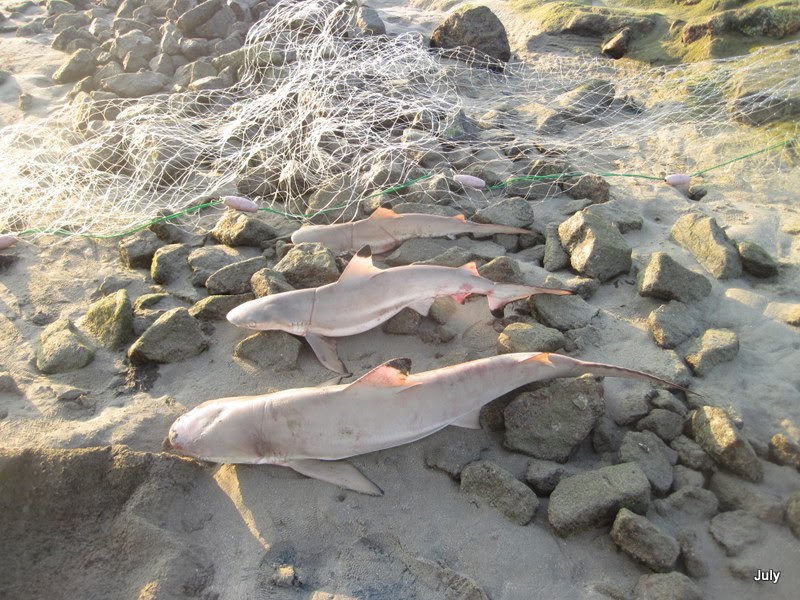
First off, I believe many of you (I refer to people who reside in Singapore) would not have believed that we can find sharks in our waters. So after this unfortunate incident and reading this and other blog posts, I believe we have contradicted this belief if you had it.

So what do we know about black tip reef sharks? First, they are known to be found in the tropical coral reefs of Indian and Pacific Region and of course, the indo-pacific seas. So it is not a odd sight to spot them in Singapore as we still possesses a number of reefs in our waters.

They prefer to stay around shallow and inshore waters. And we can usually spot them on land by their exposed first dorsal fin when they swim around in shallow waters. If you are not sure what I mean by that, think of JAWS and how the characters in these shark movies know that a shark is approaching.

At this point, it is important to point out that Black tip reef sharks seldom pose as a threat to humans unless you rouse them. They are also known to be quite timid, so it may swim away if you approach it. But please do not disturb them, because as mentioned, they might attack if being disturbed.

They are also known to stay within close areas to where they are found (most of the time), it is estimated that this distance is about 2.5km. So the ones which died and were found by us are most probably residents of the area. =(

Black tip reef sharks are also known to either live individually or in small groups. So that explains why did we came in sight of three of them.

Sharks are important to the ecosystem as they pose as one of the top predators. Top predators are important are they help to keep the ecosystem in balance.

Let me post a simple example to explain this better, let's say the black tip reef shark feeds on a fish which feeds on sea grass and only the black tip reef shark eats this kind of fish. Take note that sea grass meadows offers shelter and food for many other organisms of our seas. So if the black tip reef shark is removed from the food chain, the population of this kind of fish will be left unchecked and they will eat all the sea grass and therefore lead to a collapse of the ecosystem.

To read more about the importance of top predators, you can visit:
a) http://www.msnbc.msn.com/id/13939039

I will stop here as this post is getting a little wordy. So if you are interested to read more about Black tip reef sharks, you can visit:
a) http://marinebio.org/species.asp?id=90
b) http://en.wikipedia.org/wiki/Blacktip_reef_shark

As a final thought before I sign off, this is why Project Semakau is important to us, including you.
The aim of Project Semakau is to propose to our government to gazette Semakau as a marine park. This is to protect a part of our natural heritage for our future generations and as well as making sure marine animals such as the black tip reef shark has a place where it can safely reside it.

Monday, April 12, 2010

Project Semakau Outreach Walk on 4 April

114th Discovery Posting:

This is quite a belated posting on an inter-tidal walk on Semkau for the outreach program for Project Semakau. I will make this a short posting as there are other things that are waiting for me to complete.

First and Second 'discovery' would be a cowrie (above) and heart cockle (below) found in the picture below.
Cowries have a really beautiful shell and in the past, Polynesians have used them as some cowries as a form of currency. Till today, some people still collect them, not to use as money, but to sell them for money.

For the heart cockle, it would be easy to guess how they got their common name, their shape. Interestingly, their valve openings are located down the center of the 'heart', so when they open up, it looks a little like a heart break. =D

Third 'discovery' is the green ceratosoma nudibranch which seems to be in season in Singapore in the first few months of the year (picture below).
Fourth and Fifth 'discoveries' would be the cushion and knobbly sea star which my group, herons (if I remembered correctly) took a picture with (pictures below)Do apologize to all Herons, students from Jurongville Secondary, for such a late posting. Nevertheless, I had a great time with you all despite it being a rainy morning. =D

Extra:
For more details on this trip, read RY's blog entry: http://tidechaser.blogspot.com/2010/04/rainy-semakau-walk-on-4-april-2010.html

Monday, April 5, 2010

Hantu on 2nd April 2010

113th Discovery Posting:

The evening low tides for us to visit the shores have come and past. From now till September, it is time for us inter tidal goers to wake up at sometimes insanely early hours just to catch the tide. And over the last long weekend, I woke up from 4am to 5am for three straight days of inter tidal walk. Here's the first of them,

On Good Friday (2nd April 2010), RMBR conducted its first guided inter tidal walk on Pulau Hantu for public participants and I was the guide for the group, nudibranch.

One of the few animals that captivated my group was the fiddler crabs. Here's one of them, first 'discovery' (picture below).
The fiddler crab you see above is a male fiddler crab. We tell the males apart for their one large pincer that is almost to the same size as their bodies. Females, on the other hand, have two small pincers and they are used for feeding. For the males, because they cannot use their large pincer to feed themselves, they depend on their one and only small pincer for them to feed themselves. However, this is not to say that their big pincer is entirely useless. Their big pincer, in fact is used to attract female fiddler crabs and to intimidate other males.

Moving on, our second 'discovery' was this jellyfish found by our hunter seekers (picture below).Some jelly fishes or jellies (since they are not related to fishes =P) are seasonally abundant. According to our observation, this (above) is one of them which you can find in numbers especially in the first few months of the year. By the way, jellies have stings, and some can cause bad reactions (if you are unlucky, maybe death), so never handle a jelly with your bare hands.

Our third 'discovery' ' was this really little brittle star which I held in my hand for a little while (picture below).As their name suggests, they are really brittle, they can break their arms if they feel danger. They are also not often seen as they hide either under rocks, within sponges or on other animals. Oh, they are also related to sea stars. To be more specific, they belong to the echinoderm phylum like the sea stars and they are the largest group of creatures within this phylum.

Belonging to the group of nudibranch would mean that seeing one of them would make the trip even more interesting for the group. And boy were we lucky, we saw a total of 4 different species of nudis (pictures below). Fourth 'discovery'.

Here's the lined chromodoris nudibranch (picture below) phylid nudibranch (picture below)Polka-dot nudibranch (picture below)Black-margined glossodoris nudibranch (picture below)
If you are wondering, nudibranchs are sea slugs and they belong to the phylum of molluscs (a familiar animal found in this group would be snails). Now you might be asking, where's the shell for a nudibranch if they are related to snails? Actually, they do have shells. But it is only when they are young. When they are older, they lose their shells, one kind of defence, to get another form of defence, venom or stings depending on the species of nudibranch. So never handle a nudibranch for your own safety. =D

The last, fifth 'discovery' is the feather star (picture below). It looks much better than this if it's submerged in deeper water.
As their name suggests, their arms are a little like feathers, handle with care as they may break easily. I have seen them in many different colours besides red. They include black, yellow, white, etc. They are also related to the sea stars being in the same echinoderm phylum.

Finally, here's a group photo of all the nudibranch (picture below).Before I end, it's thanks to all who came and Kimberly who was my OJT and helped a lot during this trip =D

Extra:
a) Read RY's entry for this trip: http://tidechaser.blogspot.com/2010/04/first-intertidal-walk-at-pulau-hantu-on.html

Sunday, March 7, 2010

A Walk into the Mangroves

112th Discovery Posting:

About 2 years ago, I attended a sharing session on a study done on face-banded sesarmine from a professor. I cannot remember the name of the professor but I do remember that he mentioned that he studied these crabs in Mandai Mangroves. And from then onwards, I held this hope that I would get to see these crabs up close and also visit Mandai Mangroves. I never managed to catch a sight of these crabs in my mud 'dips' in mangroves and never could find out the exact location of Mandai Mangroves until today...

Today (7th Mar), with the guide of some friends, I had the chance to explore the Mandai Mangroves and find the face-banded sesarmine crabs.
Sidenote:
Will focus more on animals this posting since I did not really take photos of plants. =D

As we walked into the mangroves, one of the first few organisms we spotted, First 'discovery' will be mangrove horseshoe crabs (picture below).
One of the misconceptions we might have about the horseshoe crab is that it's a kind of crab due to its name. Actually, the horseshoe crab is more related to spiders and scorpions. An interesting fact about the horseshoe crab is that it has existed on Earth even before the dinosaurs! And if you are wondering if that pointy tail of it is as dangerous like the tails of stingrays, you need not worry. Their tails are not for stinging but for helping themselves to flip over if they end up underside down.

If you are interested to read more about them, click here.

The second organism, a small one was first spotted by RY. It is a mangrove big-jawed spider if I am correct (picture below). Second 'discovery'.
They are spiders commonly found in our mangroves. You might not spot them as they stay motionless on a leaf or branch and their stick/branch-like appearance. Although both genders of this kind of spider has big jaws, the males jaws are particularly elongated and are equipped with a spur each. They help them in locking the jaws of the female during mating.

After about a slow walk into the mangroves, I finally come across the face-banded sesarmine crabs (pictures below)! Third 'discovery'!Their name is as such due to the bright green or blue (I think I saw yellowish ones as well) band on their faces. Very interestingly, the bands on their faces can reflect light! And a study suggests that the different colours of their bands plays a role in sexual recognition. It is reported that the males of these crabs (to be more specific: 2 species) have more intense blue facial bands while the females have more green facial bands.

To read more about them, click here.

In conclusion, Mandai Mangrove is a really nice mangrove where you can find a great number of crabs and a number of mangrove plants (including rare ones). However, it is not for the average urban dweller, as you will get really muddy and even sink then stuck in the mud at times. And of course, the stink of mud after the trip and mosquito bites. All other things aside, it is a great mangrove. =D
Thanks to everyone who made it for the trip. I bet all of us had a nice and muddy time! =P

Tuesday, March 2, 2010

Semakau over the last weekend of Feb

111th Discovery Posting

It has been a mini hiatus from blogging recently and now I'm back!

On this recently passed weekend, I visited Semakau twice for two different reasons. Both were for Project Semakau, however the Saturday trip was for a transect monitoring session while the Sunday trip was for a guided trip for schools where I was to be a hunter seeker.

This entry is a summary of some of the things which I found or saw.

First up is something which I managed to spot for 2 days in a row, the spider conch (pictures below). First 'discovery'.
Normally, it is quite hard to spot the spider conch as they are well camouflaged amongst the reefs or rubble area. Their camouflage can come from the algae growing on their shell and even sand which covers it. Once flipped over, you can see that its shell is actually really pretty. That is why people collect their shells and at the same time, people collect them for food. Additionally, places for them to live in are hard to come by in Singapore now due to development. So due to these reasons, they are now considered uncommon in our waters.

Another uncommon marine organism in Singapore is the knobbly sea star. Semakau is one of the few places where one can find a significant number of them. Here are some of the knobbly sea stars I saw on Saturday (picture below). Second 'discovery'.
The knobbly sea star's name is as such because of the knobs present on its body. It is believed that these knobs deter predators from eating them. However, fishes like the puffer fish are known to eat them.

The knobbly sea star is also somehow one of the highlights of Semakau or any other inter-tidal walks. This is because they can grow up to about a width of 40cm wide, so they can be a 'BIG' star.

Beside the knobbly sea stars, you can also find cushion sea stars on Semakau. Here are some juveniles (picture below). Third 'discovery'.
Here's a 'adult' sized cushion star (picture below).It's always a joy to see a big cushion star as they are more commonly seen by divers in deeper waters. For the juveniles, they probably like to hide in the seagrass area before moving deeper into the reefs once they are of the right size/'age'. They have been reported to feed on organic particles found in the sediments, immobile animals and even on corals.

And of course, not to forget the common sea star (picture below). Fourth 'discovery'.All sea stars (which I know) has a water vascular system. This is like our blood circulatory system where blood is pumped all around our body. But instead of blood, the sea stars pump sea water around their bodies. So it is best to handle the sea stars in sea water if you want to touch them.

The last thing I wish to write about is this nudibranch which I have never seen in Singapore. It's a Varicose phylid nudibranch (Phyllidia varicosa). Fifth 'discovery'.The phylid nudibranchs are said to be one of the most toxic nudibranchs. It is said that if they are stressed or feel endangered, they will release a toxic chemical into the waters near them. This toxic can kill a whole fish tank of fishes if ever released into one. So to be on the safe side, don't ever handle this nudi.

That's about warps up this posting. Thanks for reading and everyone who were on the trips on both days for making it another great weekend out.

Extra:
1) KS's entry for the Sunday trip: http://wondercreation.blogspot.com/2010/02/two-new-nudi-sightings-for-me.html

Sunday, January 3, 2010

Starry Starry Semakau on 2nd Jan 2010

110th Discovery Posting:

It was another day out at Semakau. Most of the group went to explore the normal route with their friends, LK was off to locate some rare plants, while a small group of us had one main objective in mind: that was to find the galloping sand star spotted last time.

We were not disappointed as I managed to spot one not long after I started combing the area which I last saw one. Our first 'discovery' (picture below).
As mentioned below, this galloping sand star is special not only because it can move by jerking or leaping (we didn't really saw this occurring because we did not had the luxury of time to observe it for long). It is also special because previous specimens has only been found through dredging. Thus plus this time, it is only the second time that anyone in Singapore has seen/recorded (according to what I know) it in an inter-tidal area.

As we walked around, we came across numerous upside down jellies, here's one of them, our second 'discovery' (picture below).Upside down jellies are upside down because of the fact that it harbours algae in its body and by being upside down, the algae will be able to do photosynthesis. So what's the big deal? The deal here is that, the algae will share any extra food to the jelly while the jelly provides a home for the algae. Basically what I call a "you scratch my back, I scratch your back" relationship. =D

Our great luck continued as Marcus soon spotted another galloping sand star (picture below). Both of the galloping sand stars we saw didn't look in great condition. Hopefully they will recover and be healthy again when we see them again.

It was really a great day out as we also came across 3 sea cucumbers which were never-seen-before in Semakau, I decided against posting the photos of them on this posting as R had better photos of them. I'll provide the link to his posting at the end of this posting so all interested discoverers can take a look at them =D
Moving around the area, we also came across a few hell fire anemones, here's one of them, our third 'discovery' (picture below).They are named hell fire anemones because of the fact that your hand will feel as if it's on fire if your hand comes into contact with it. I don't have any personal experience to back this up. But on a second thought, I don't think it's an experience I would want to have if possible...haha

The last time when I was around the same area, I came across a number of bigfin reef squids around the area. So I decided to try my luck again and I was not disappointed. Here's two of them, fourth 'discovery' (picture below) It has been said that squids are probably the fastest moving aquatic invertebrates with some reaching up to 40km/h but the ones we saw were quite still. Maybe it was their break time? haha

Some people like me tend to mix up squids and cuttlefishes, so one good way to tell them apart is to look out for fin. An all round fin is a cuttlefish while the squid's fin is a triangular flap at the tip of the body which acts as stabilisers.

To read more about them, you can go to http://www.wildsingapore.com/wildfacts/mollusca/cephalopoda/squid.htm.

This trip just seems to get better as the night approached. I say this because I spotted a total of 20 plus knobbly sea stars as I walked around (picture below). Basically, I spotted one for average every five steps I took. Wow.

To top it all up, the evil knobbly, Pentaceraster mammilatus, came into view as I changed direction to head back. Woohoo! Fifth 'discovery'! A Pentaceraster was last seen on Semakau about a year ago, so it's great to discover another one on Semakau. =D

This trip surely lines up as one of the top trips I had on Semakau and it was all with great weather and company!

Extra:
Read http://tidechaser.blogspot.com/2010/01/3-new-sea-cucumbers-at-semakau.html for the 3 sea cucumbers which are new records for Semakau.

Friday, January 1, 2010

Pulau Hantu on New Year's Day 2010

109th Discovery Posting:

Today (now: yesterday) is (now: was) the first day of 2010 and I was out on an inter-tidal area with friends at Pulau Hantu.

The inter-tidal area on the island itself isn't really huge but it does have a variety of 'attractions'. First, there are some mangrove trees which one can get really close up and observe their aerial roots (picture below).
Second, you are able to find some marine organisms found in some other inter-tidal areas in Singapore. Take for example, our first 'discovery', a common sea star (picture below). If you follow my postings, you will find that I sometimes bemoan the fact that despite being named the common sea star, this species of sea star is actually not common in Singapore. This is probably mainly due to the loss of habitat. However, in the past few months, they have been spotted at Sentosa and more recently, many in numbers at Tanah Merah (a reclaimed shore). I hope this is a sign that they can really become common.

Second 'discovery' would be something that you 'die-die also can see' unless something drastic happens (for example: water pollution), touch wood. Anyway, I am referring to corals. Here's a flowery soft coral (picture below).They are nice to look at but bad to touch. They will not break of course, but they can sting you, so it would be a good idea not to touch them. Anyway, do take a closer look whenever you come across one of these as you might come across tiny animals that can live on this kind of soft coral. I didn't really take a close look this time, but you can see some examples from this link.

Our third 'discovery' is also a coral. This is a mushroom coral (picture below)Mushroom corals are corals with a ... er ... two differences from other corals. One, unlike other corals which are attached on the ground/substrate/rock, the mushroom coral when as a adult lives unattached to those mentioned. Two, unlike corals which are mostly made up of many individual animals (named: polyps), mushroom corals are made up of either one polyp or sometimes a few.

Next up, our fourth 'discovery', a flat worm (picture below). As their name suggest, flatworms are really flat. This can help them to squeeze or move into narrow and small spaces to find food and at the same time to hide from their predators. At the same time, being really flat means that their bodies are easily tore when handled, so please handle them with them or don't handle them at all. One really interesting thing about them is that flatworms are hermaphrodites. In really simple terms, this means that a flat worm is both a guy and gal. In specific terms, flatworms have both the male and female reproductive organs.

Does this (picture below) look tasty to you? I bet crab lovers will drool over this...
However our fifth 'discovery', the red egg crab, is a crab which crab lovers should avoid as they are poisonous and more importantly, their poison CANNOT be wiped out by cooking.

Our sixth 'discovery' may look like a flatworm which you have seen earlier, however this is a nudibranch (picture below). To be more specific, this is a Bohol nudibranch, Discodoris boholiensus.As mentioned, you might have taken this as a flatworm. No worries, this happens to us sometimes as well. So how can we and you not make this mistake. Here's a site for help: http://www.wildsingapore.com/wildfacts/glossary/flatwormslug.htm

And lastly is the highlight of our trip, the seventh 'discovery', a....SEAHORSE (picture above and below)!I believe you might already know that an interesting fact about the sea horse is that the father carries the eggs of its young, in other words, get 'pregnant'. But do you know that seahorses are actually related to fishes but not horses. There are many more information about them, you can read them at http://www.wildsingapore.com/wildfacts/vertebrates/fish/syngnathidae/hippocampus.htm.

That about concludes this posting. Would like to thank R for organising this trip and all who were also there. It was another nice although short trip. =D